

Watch the Journey Unfold:
📸 Instagram | 🎥 TikTok | 🎬 YouTube | 📘 Facebook
I waited anxiously as the ringing dragged on. The low-pitched buzz stung a little more with each repetition. Finally, a voice came on the other end, and my stomach clenched. The translator began her pitch. I could only pick out a few words, but I knew the rhythm; she had delivered it so many times before. The gentleman on the other end grumbled a response. He rattled off a ten-digit number and hung up.
I waited until I couldn’t stand the silence any longer.
“Well … good news?”
“He said they aren’t interested, but you can message them here if you’d like.”
Another strikeout. For weeks, my calls and WhatsApp messages had been rebuffed. Emails and letters went unanswered.
After months on The Tea Trail, the resistance felt abnormal. Until then, tea had only opened doors. People had been eager to share their passion with a foreigner intent on carrying their stories home.
But in Indonesia, tea seemed to be closing them.
So I changed my approach. If I wanted to understand Indonesian tea, I had to seek it out uninvited. No welcoming committee, no guarantees, only a story to uncover.
Why had an industry that was usually so open suddenly become so difficult to enter?
After arriving in Bandung, West Java, I continued trying to reach some of the industry’s largest national players, showing up at offices and tea houses in the hope of finding a way in.
While waiting for a response, I visited a national forest just beyond Bandung’s urban sprawl. The path wound through a dense canopy and past military tunnels built during successive occupations. The trail climbed toward the park’s centerpiece: a cascading waterfall nearly as wide as it was tall.
It was there that I met Bambang, a Bandung native my age who had gone for a walk to spend a little time away from his multigenerational household.
We walked and talked about his work, his girlfriend, local politics, and, of course, tea. I told him about the trouble I was having finding a way into the industry.
“Well, I know there are some problems up there. Maybe that’s why.”
I asked what he meant.
“Well, I don’t know much about this, so don’t take my word for it,” he cautioned.
“But some people say it’s like the colonists never left.”
As soon as I returned to my room, I began researching what he meant. The Dutch had established a vast tea-export industry on Java during the nineteenth century. The Dutch East Indies eventually became the world’s third-largest tea exporter, at one point surpassing China.
The tea trade was disrupted by World War II and the Japanese occupation. But the war also helped create the conditions for Indonesia’s declaration of independence in 1945, which the Netherlands formally recognized four years later.
I had a rough understanding of this history. What I hadn’t appreciated was what succeeded it.
In the years after independence, the state gradually took control of many formerly Dutch-owned tea estates. The plantations offered the young nation an established source of export revenue.
Tea was only one part of an extraordinarily productive colonial export economy. Before the war, the archipelago produced 85 percent of the world’s pepper, 33 percent of its natural rubber, and roughly 20 percent of each of the world’s coffee, tea, sugar, coconut, and palm oil products.
But that inheritance came with a contradiction. For some Indonesians who had fought for independence, transferring colonial estates to state control did not necessarily feel like liberation.
So I began to wonder whether it was merely red tape or whether something deeper lay behind the bureaucracy.
After another week and one more letter, I got a message back. Fully expecting another polite rejection, I opened it with a sigh. My eyes widened when I read the words.
Your request has been approved.
Once I made it through the administrative hurdles, everyone was kind and accommodating. Invited to choose from PTPN’s government-owned estates, I requested a tour of the Rancabali Tea Plantation, nestled in the Ciwidey highlands. The estate was known not only for its beauty but also for nearly continuous tea production stretching back to the 1870s.
Our dated sedan bounced along the bumpy road toward the factory entrance. As soon as the car door opened, I was greeted by the familiar semisweet aroma of freshly plucked leaves that hangs outside tea factories.
But the scent was where the familiarity ended.
The facility was larger than any I had visited before. Rancabali manages 7,500 planted acres and four processing facilities, each producing up to 18 tons of tea per day. Yet it is only one of many estates in the region.
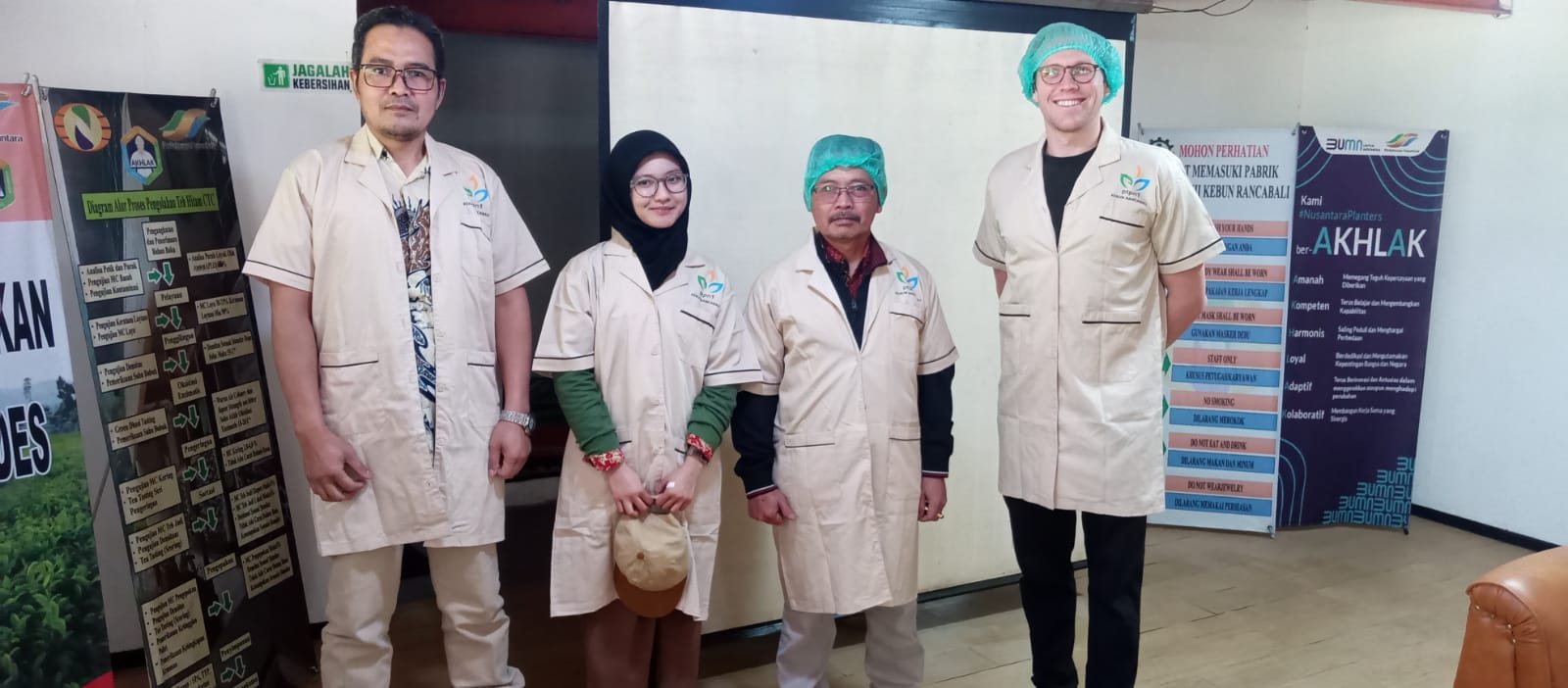
Once inside, we were handed standard-issue coats and hairnets. The factory leadership guided us through several floors of machinery. The twenty-four withering beds could collectively hold up to 20,000 kilograms of fresh leaves. Above them, a looping overhead conveyor system carried baskets of tea to the assembly line.
The machinery ran for fourteen hours per day, moving product through withering, rolling, oxidizing, drying, separating, loading, and packing. Fifty-kilogram sacks of finished tea were stacked eight high on pallets destined for Bandung.
That day, I did not uncover the abuse or conspiracy I had half expected. Instead, I found something potentially more consequential: an enormous industry being administered on borrowed time.
Most of the buildings were more than a century old; much of the equipment was approaching half that age. In the years since they were built, the tea world has changed. A new production method known as CTC—cut, tear, curl—spread through major tea-producing regions, reducing time and cost while ensuring a consistent product suited to mass-market blends. This led to the emergence of Kenya as the leader in modern tea exporters. Other producing countries, most notably Sri Lanka, continued to rely heavily on orthodox processing. To compete, those industries placed greater emphasis on quality, origin, and national identity.
For decades, Indonesia struggled to establish itself firmly in either market. With its tea positioned as neither cheap nor premium, the country found itself losing ground. Once responsible for a fifth of global tea exports, Indonesia now accounts for less than 2 percent.
In 2025, tea’s diminished place in national agricultural policy became explicit. The new presidential administration named agricultural commodities in which it intended to make Indonesia a global leader through financing, research, and modern technology. The list included nutmeg, coconut, palm oil, rubber, coffee, cocoa, pepper, and garlic. Tea, once classified among Indonesia’s “premier plantation commodities,” was notably absent.
At Rancabali, managers said they had not yet felt any direct effects from the policy. But PTPN manages businesses spanning roughly a dozen agricultural commodities, and its leaders are often transferred among those operations. Several of the people overseeing Rancabali had neither studied tea nor grown up in the industry. Most said they were not regular tea drinkers themselves.
“I prefer coffee,” one plant manager said unapologetically.
“So do I,” his supervisor added with a nervous laugh.
For the first time on the trail, I was meeting tea managers for whom the product was primarily a profession rather than a lifelong passion. There is nothing inherently wrong with that. Still, a similar anonymity appeared in the cup.
The tea I sampled was consistent and functional, each grade calibrated for a different commercial use, from bitter blends to maltier brews. But none bore the unmistakable imprint of one of the world's most historic tea-growing regions.
Rancabali was not my only window into the industry. PPTK, the Indonesian Research Institute for Tea and Cinchona, hosted me for a day at what it describes as Southeast Asia’s largest tea research center. Just below the peak of a dormant volcano, researchers have studied tea here since the late 1800s, contributing to decades of advances in Javanese cultivation and processing.
There I met Fadil, a young researcher focused on socioeconomic development. He proudly showed me around the institute, parts of which also dated to the nineteenth century. It all started conversationally, with Fadil pointing out famous monuments as we sampled the institute’s new product lines. But as our questions moved from the institute’s history to tea’s future, his tone changed.
With each question, it became clearer how quickly the industry around him was contracting.
“Two years ago we produced 10 to 15 tons of tea per day. Now, it is 5 to 7.”
He attributed the decline to several factors, including outdated infrastructure, aging tea bushes, and diminished attention from the national government. But he emphasized one factor above the others: climate change.
Climate adaptation has therefore become central to his work. The center is working to understand how tea plants respond to their changing environment and even how those plants might help protect the landscapes where they grow.
“Because of its deep root systems, tea can help stabilize the soil,” said Erdiansyah, the head of the institute’s agronomy research department, whom Fadil introduced as his “boss-boss.”
“Tea can be effective at preventing erosion in the areas at most risk.”
I reviewed some of the latest research they had presented to government officials in support of greater investment in the nation’s tea industry. The researchers argued that tea cultivation could support watershed protection, carbon-sink capacity, and ecosystem conservation.
“We are trying to show the environmental value, the cultural value. But it’s very difficult. How do you show the exact impact if you rip up those tea plants and allow a landslide? How do you put that into rupiah?”
Erdiansyah leaned closer and placed an open palm on the table.
“That is what we are trying to do.”
At PTPN, tea was still being produced on an immense scale, largely as one commodity among many. At PPTK, researchers were trying to prove that tea possessed forms of value the commodity market could not see. One institution was maintaining the machinery; the other was searching for a reason to keep it running.
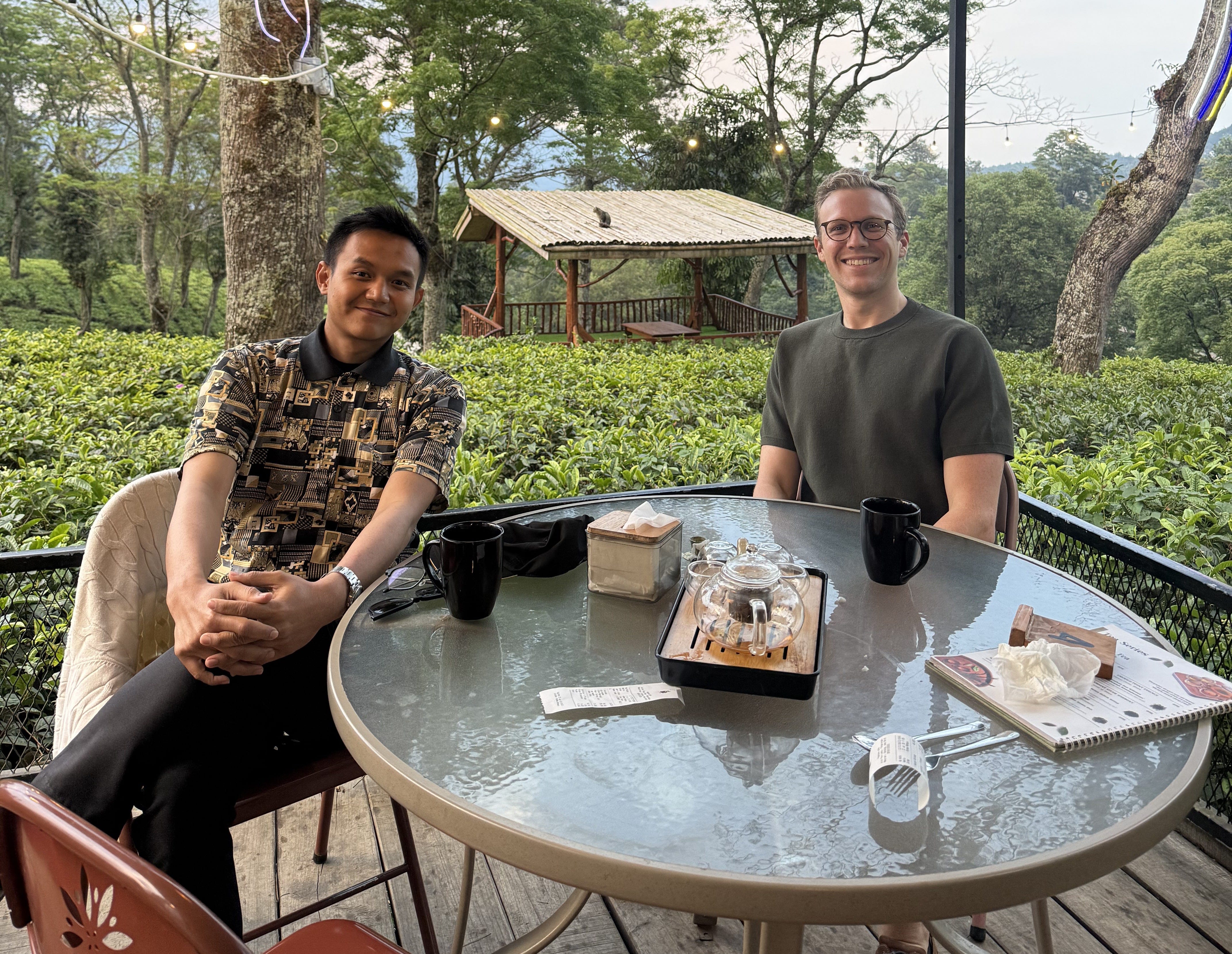
On my last night, Bambang and I met for a farewell dinner. He took me to a family favorite, where a Sundanese meal arrived as dozens of small dishes spread across the table. He particularly wanted me to try the restaurant’s version of Teh Talua, a frothy West Sumatran drink made from raw egg yolk, sugar, and strong black tea.
The Dutch brought tea to Java to supply consumers thousands of miles away. But once it was here, Indonesians began making it their own. The drink in front of me belonged unmistakably to the people who had inherited it.

Perhaps Indonesia does not owe tea a future simply because the Dutch gave it a past. But it would be foolish to imagine a clean break after generations of Indonesians have built their lives around it.
The colonial tea industry, in its original form, is already gone. The dilemma is whether something distinctly Indonesian can—or should—grow from what remains.
When a country inherits an industry it never asked for, is its disappearance a loss or a form of liberation?
Sources
Prabowo Targets Global Supremacy for 10 Commodities — Antara News. Overview of the Indonesian government’s current agricultural strategy and identification of the ten priority commodities.
Indonesia Annual Estate Crop Statistics 2024 — Statistics Indonesia (BPS). Official production, area, yield, and plantation statistics for tea, palm oil, coffee, cocoa, rubber, and other leading estate crops.
Political Economy of Indonesia’s Plantation Sector — Jurnal Politik Hukum Indonesia. Analysis of state policy, plantation governance, and the historical evolution of Indonesia’s estate crop system.
Indonesia (7th Edition) — Lonely Planet (Patrick Witton et al., 2003). General historical, cultural, and geographic background on Indonesia, including context for colonial history, regional differences, and travel logistics.
Socio-Economic Research Team Reports — Indonesian Research Institute for Tea and Cinchona (IRITC/PPTK). Industry research on the economics, competitiveness, and development of Indonesia’s tea sector. Materials available upon request.