

Watch the Journey Unfold:
📸 Instagram | 🎥 TikTok | 🎬 YouTube
It was pitch black by eight, with almost no streetlights to illuminate the road as the cherry-red Suzuki Stingray headed straight for Sri Lanka’s interior. The car’s clouded headlights illuminated only a few yards of road. That didn’t seem to deter the driver who barreled ahead, sweeping through quick turns and shifting gears like a rally driver.
Beyond my window, the roadside appeared only in flashes: groups of women with baskets atop their heads, bony cows grazing along the asphalt’s edge, dogs lying well inside the shoulder lines. Every few minutes, we slammed on the brakes as a crimson bus careened toward us, passing whatever was in its way, its horn blaring to announce its approach.
After three and a half hours and eighty miles, we arrived at our destination. Beyond the frenetic highway was a newly paved road lined with twenty-foot-tall hedges and towering palms. Eventually, the landscaping gave way to a three-story building fronted by a grand porte-cochère and wrapped in glass panes with more surface area than a Manhattan apartment.
“What is this place?” I muttered.
By morning, I could finally see where I had been dropped. Hundreds of people stood at the bottom of the stairs, dressed in sharp suits and elegant dresses, waiting for a wedding to begin. Feeling conspicuous, I slipped down a back stairwell and waited outside.
As I stood there, businessmen hurried between buildings. The dress code was well-defined: a crisp button-down shirt tucked into pleated slacks and a pair of leather dress shoes. The color of each article was an opportunity to express personal style.
Their most important appendage was a cellphone. Drivers held old Nokia candybar phones, middle management tapped away at touchscreen Androids, while senior leadership sported the newest iPhones. No matter their rank, another buzz was always emanating from a breast pocket.
“I get calls about everything. If a machine goes down, if there’s an issue with an employee, I hear about it,” said Deelaka, a director at the KDU Group, a tea producer that has grown to include 15 subsidiaries. He was the third generation of his family to join the business founded by his late grandfather K.D. Upasena in 1978.
I would learn that his hands-on approach wasn’t just managerial; it had been shaped, in part, by what his family and country had lived through.
British planters introduced tea in the mid-1800s, after a fungal outbreak decimated the island’s coffee crop. In the ensuing years, colonial Ceylon became one of the world’s leading plantation-export economies.
But Sri Lankan independence in 1948 opened a new chapter of political tension. By 1983, a militant separatist group known as the Tamil Tigers was waging an insurgency against the government, beginning a civil war that would last more than a quarter century.
Post-independence policies favored the Sinhalese majority and were experienced by many Tamils as political, educational, and economic exclusion. Decades of grievances boiled over into a variety of separatist movements in the island’s northern and eastern provinces. Over time, the Tamil Tigers became one of the world’s most notorious insurgent movements, employing suicide bombings, assassinations, massacres, and the recruitment of child soldiers.
“I remember three bombings happening outside our house, all within a few months of each other,” Deelaka told me. He had spent the first fifteen years of his life in the shadow of war.
Credible evidence indicates that both sides committed war crimes, and estimates of the death toll exceed 100,000.
While most of the country’s tea-growing regions were far from the heaviest fighting, the economic impacts stretched across the island. During the war, the government devoted nearly a quarter of its operating budget to defense and imposed a “National Security Levy” on business activity that ranged from 4.5 to 7.5 percent over the course of the conflict.
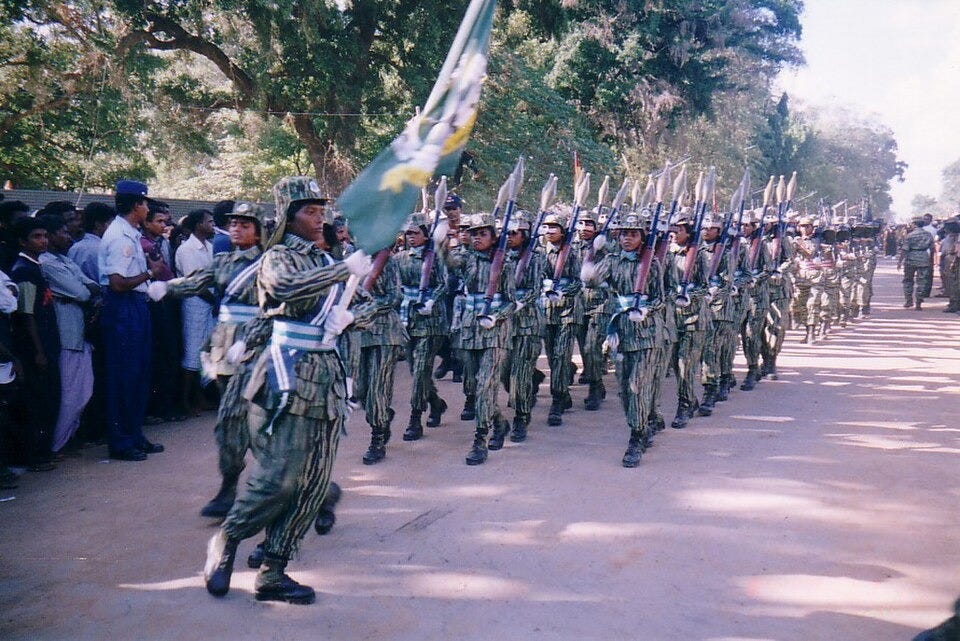
Recovery after 2009 was measured nationally in GDP growth and reconstruction spending. For many Sri Lankans, it simply meant the opportunity to begin building again. Tourists returned, estates grew more productive, and foreign investment arrived, all taking advantage of the island’s economic potential.
Deelaka showed me around one of those estates. The ride up was winding, as the major two-lane roads narrowed to a generous single one.
More than once, we came upon a temple beautifully adorned with strings of blue and white bulbs illuminating its pastel-painted finials People cheered as elephants, cloaked in gold-lined regalia, proceeded through the streets.
Worshipers had erected dansalas, small stalls offering free food and drink as an expression of dāna, the Buddhist virtue of selfless generosity. Over the course of my trip, I was offered fresh juices, pillowy dough pockets stuffed with perfectly spiced lentils, and crunchy sweets covered in coconut treacle.
As we continued up the mountain, we spoke more about his entry into the family business. “From the time I was seven years old, I always loved being at the factory.” Deelaka described himself as a barefoot child, wandering through the halls after school, taking withered leaves and trying to make tea himself.
That morning he swapped bare feet for Louis Vuitton loafers. “Just because you’re here,” he quipped. Many others around the plantation going shoeless.
We watched as farmers plucked new tea shoots, tapped rubber trees, and stripped cinnamon bark. This estate, like all the others I visited, was diversified. I began to notice that the pattern extended beyond the fields.
As we walked around town, people tried to sell me everything from uncut gemstones to bags of goldfish. We visited one family home that included a tea garden in the back and a fly-fishing lure workshop on its first floor.
People here seemed reluctant to depend on any single thing. After decades of war and repeated national crises, diversification had become less an investment strategy than a way of life.
On Easter morning in 2019, a series of coordinated terrorist attacks unfolded across Sri Lanka. The bombings became the deadliest ISIS-linked attack outside Iraq and Syria, killing an estimated 269 people.
For many, it was a quick regression into the realities of the war-torn decades that preceded it. Tourism cratered overnight. Then, a year later, the COVID-19 pandemic eliminated what little remained. Within three years, the domestic economy collapsed, and in May 2022, Sri Lanka defaulted on its foreign debt for the first time in its history.
The populace revolted, swarming the presidential palace and forcing the country’s leadership to flee and resign.
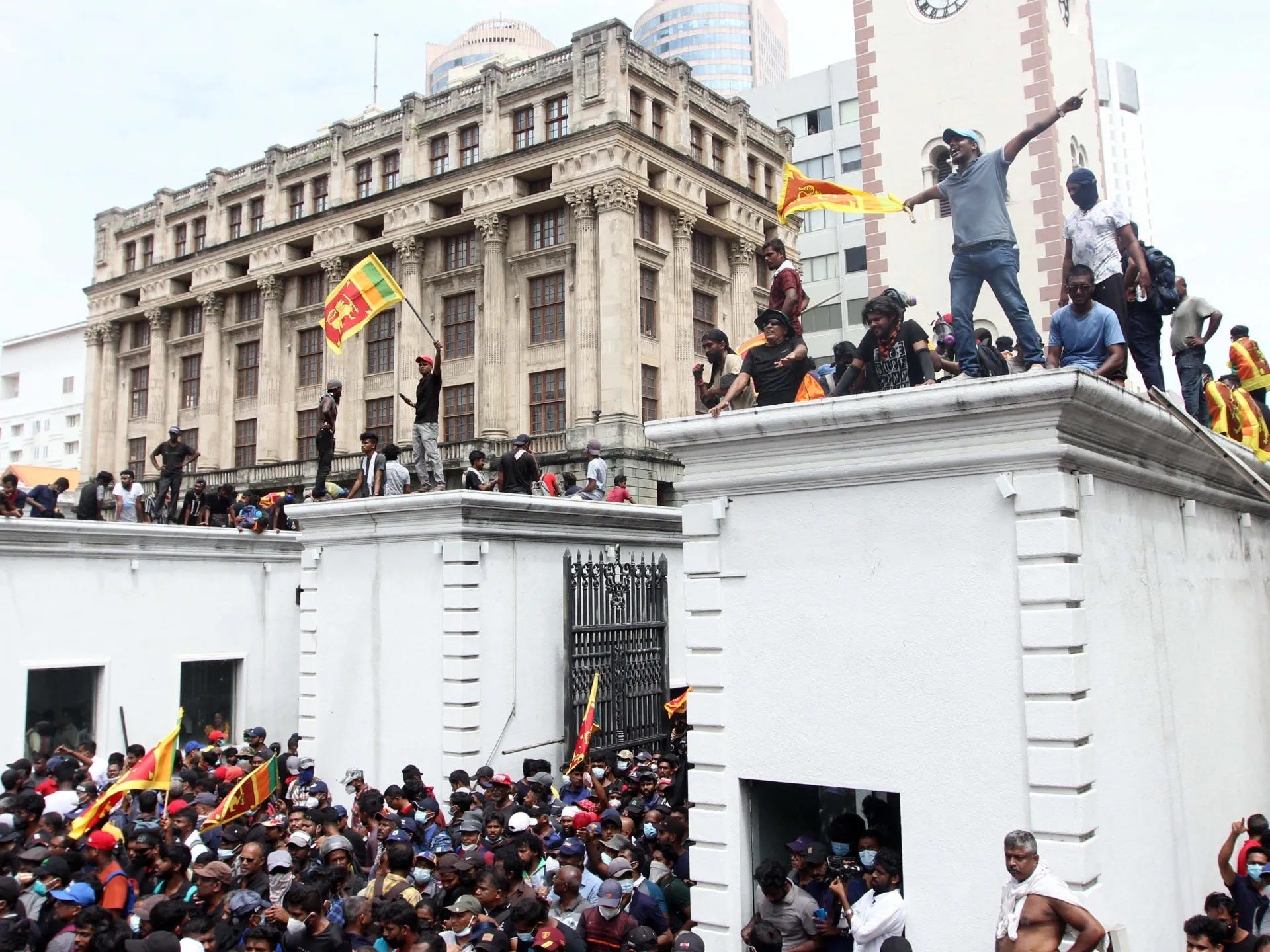
But Sri Lanka may have been uniquely adapted to respond to such a blow. Away from Colombo, the country still had to move on. Tea needed to be plucked, rubber tapped, and cinnamon stripped. Where the government fell short, responsibility increasingly fell to the private networks that industry had created.
We visited Mr. Athapattu, a local farmer who was one of KDU’s more than 15,000 suppliers. His 15-acre estate classified him as a mediumholder, and he had cultivated the land for 25 years.
Tall and muscular, he was one of the few people I met in Sri Lanka who towered over me. As I asked questions about the past, he mostly brushed them off. Instead, he was more interested in speaking about the current crises the industry faced.
“We have a labor shortage and climate change that is hurting us.”
Nearly every grower I’d met had told me the same thing. What I had yet to learn was how companies like KDU were responding.
“We have an extension team that goes out to provide support,” Deelaka said.
“They give practical knowledge and try to provide what we call 360 support. It starts with agricultural benefits like soil testing and even extends to financial support, facilitating loans from a local bank to help with everything from new irrigation systems to replanting.”
When areas need roads, they help provide the funds. When the community wants to build a new temple, they provide the building materials to support the effort.
Deelaka did not try to fool me; he was clear that the investments were self-serving. They rely on their suppliers for the leaves that they eventually turn into tea. Protecting the roads and crops their operation depended on was simply good business.
“When the government fails or the budget falls short, the private sector fills in,” he added.
The clearest example came during COVID. The main hospital in Ratnapura, home to KDU’s largest factory, was, like countless others around the world, unprepared for the scale of the crisis. The company stepped in and financed a centralized oxygen system for the facility.
“That alone saved thousands of lives.”
As we prepared to leave, I asked Mr. Athapattu whether he thought his children would still be plucking tea there fifty years in the future.
“I certainly hope so. Right now we don’t know anything for sure; all we can do is continue to work against all that is ahead.”
Our final stop was the Galpadithanne Tea Factory. It was the company’s first location, initially leased by K.D. Upasena back in 1972. A decade ago, it held the status of the world’s most productive orthodox black tea factory, producing more than three million kilograms of product annually.
The complex was enormous. It had its own bus network to transport employees from distant regions, generators to sustain operations during grid failures, and a fueling station for more than 100 trucks bringing leaves from smallholders.
We were joined by the plant manager, Upul Janaka, who showed us around the four-story building.
Once I looked past its scale, I could start to see the many innovations that made this one of the most technologically advanced factories in the country. Among them was a digitized scale connected RFID chips with a proprietary app that allowed estate owners to track weights, deliveries, and payments. Those producers could then access the ATM at the facility’s to take out cash within 24 hours of delivering product.
But in my view, those systems went beyond efficiency. Each innovation was an opportunity to build trust. The factory was connective tissue between thousands of people who relied on one another.
As we prepared to leave, I pulled Upul aside to get his candid answer. What was the biggest challenge in running such a massive operation?
“Dealing with the director!” he shouted, Deelaka still in earshot.
After we’d all had a good laugh, he struck a more serious tone.
“It is trying to predict what happens outside.”
As things wound down on my visit, Deelaka and I sat down for dinner. We shared a club sandwich and a pot of tea. The chicken had been replaced with mushrooms because Deelaka had not eaten meat since he was seven.
After everything I’d seen, I had to ask the question that couldn’t leave my mind.
“Why did you come back?”
He met his wife and earned his degree while in the U.K.; with his connections and resources, he could have easily stayed and built a life there or anywhere. For him, the choice was simple.
“There is nothing like home.”
I then asked him what he was most proud of. He didn’t hesitate.
“People.”
When I later sat down with his father, Mr. Saman Upasena, I asked what made him most proud. He gestured toward the palatial hotel that had so surprised me on my first night.
“You wouldn’t think this kind of place is suitable to have here. If you wanted to make more money, you should have built this in Colombo.
“But my belief is that we should not underestimate our own people.
“Now they have a lot of belief. They have been using this place, and it has been recognized.”
We often speak of resilience as an individual quality, the grit you build in order to endure. But Sri Lanka had shown me a different version: resilience can also come from a network of people who understand success as a collective endeavor.
KDU was still a business, and it acted in its own self-interest. But their definition of self was wildly different. I now understood why they were so intent on describing this conglomerate as a family business. After immense growth and decades of change, its fate still depended on the trust it had earned.
The hotel I entered on the first night no longer felt so out of place. It was not a monument built to flaunt what had been accumulated. It was a testament to a family that refused to underestimate the people around it.
Sri Lankan tea was started by outsiders and cultivated for foreign consumption. The people who inherited it chose to do something the colonial plantation economy was never designed to: turn an industry into an institution that invested in people rather than simply extracting from them.
Choosing instead to sustain communities that, in turn, sustained them.
Sources
History of Ceylon Tea: Independence and After — Sri Lanka Tea Board
The Economic Cost of the War in Sri Lanka — Nisha Arunatilake, Sisira Jayasuriya & Saman Kelegama, World Development (2001)
Annual Report 2009: National Accounts of Sri Lanka — Department of Census and Statistics, Sri Lanka
National Security Levy Act, No. 52 of 1991 — Government of Sri Lanka
About KDU Group — KDU Group.
Sri Lanka Country Profile — BBC News
Interviews conducted in Sri Lanka (July–August 2026)
Wow that was an amazing story. 👍
Loved it Connor. Keep them coming.