

Watch the Journey Unfold:
📸 Instagram | 🎥 TikTok | 🎬 YouTube
Tea powered China’s army.
Just not in the way you’d think.
By the Tang dynasty, China faced mounting pressure from nomadic cavalry powers.
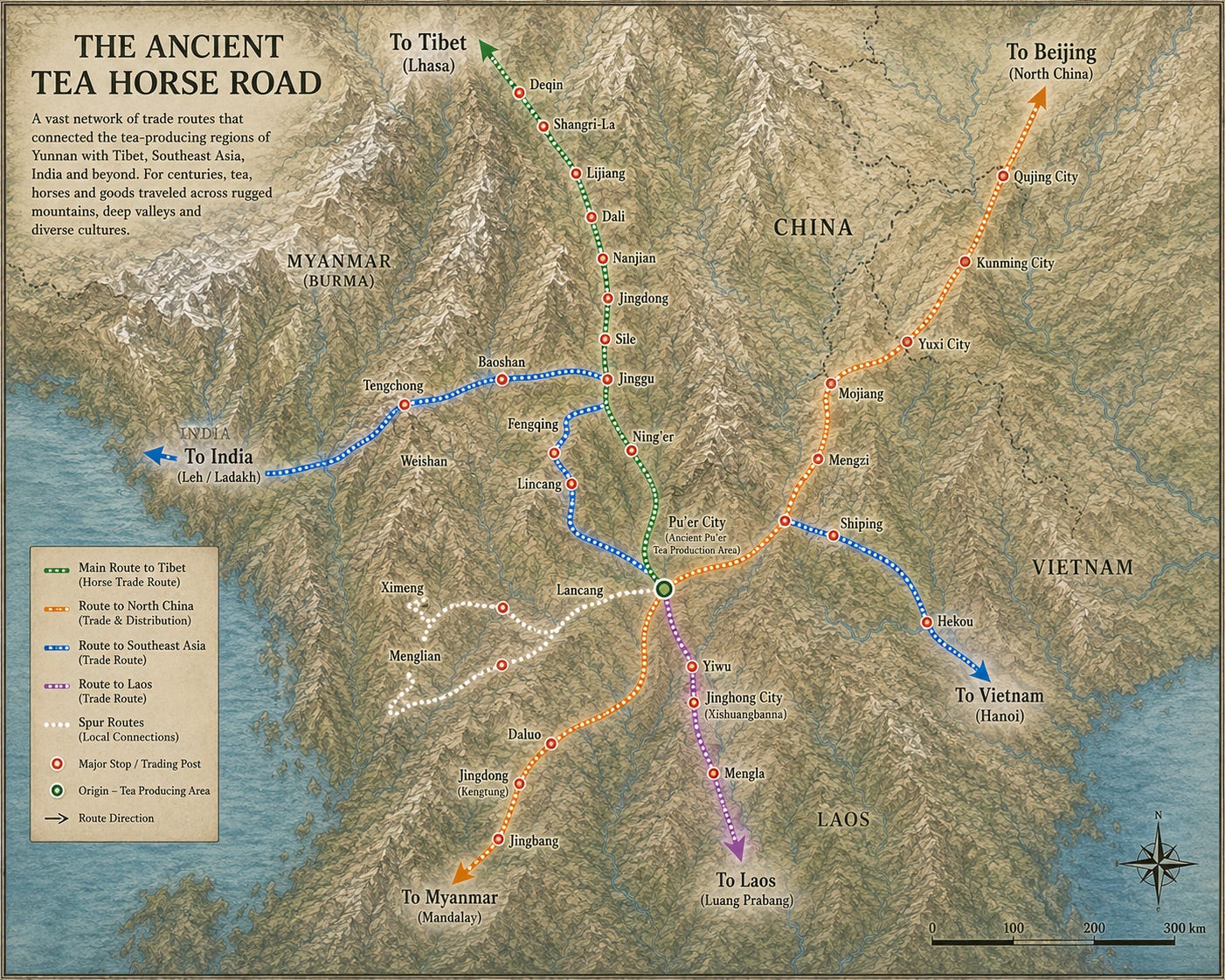
But they couldn’t produce horses in the quantities their military needed, so they built a system to acquire them: tea into Tibet, horses back to China. The terrain in between was among the most treacherous on Earth, requiring months of sustained endurance to complete. But the strategic value justified the danger.
This would come to be known as the Ancient Tea Horse Road.
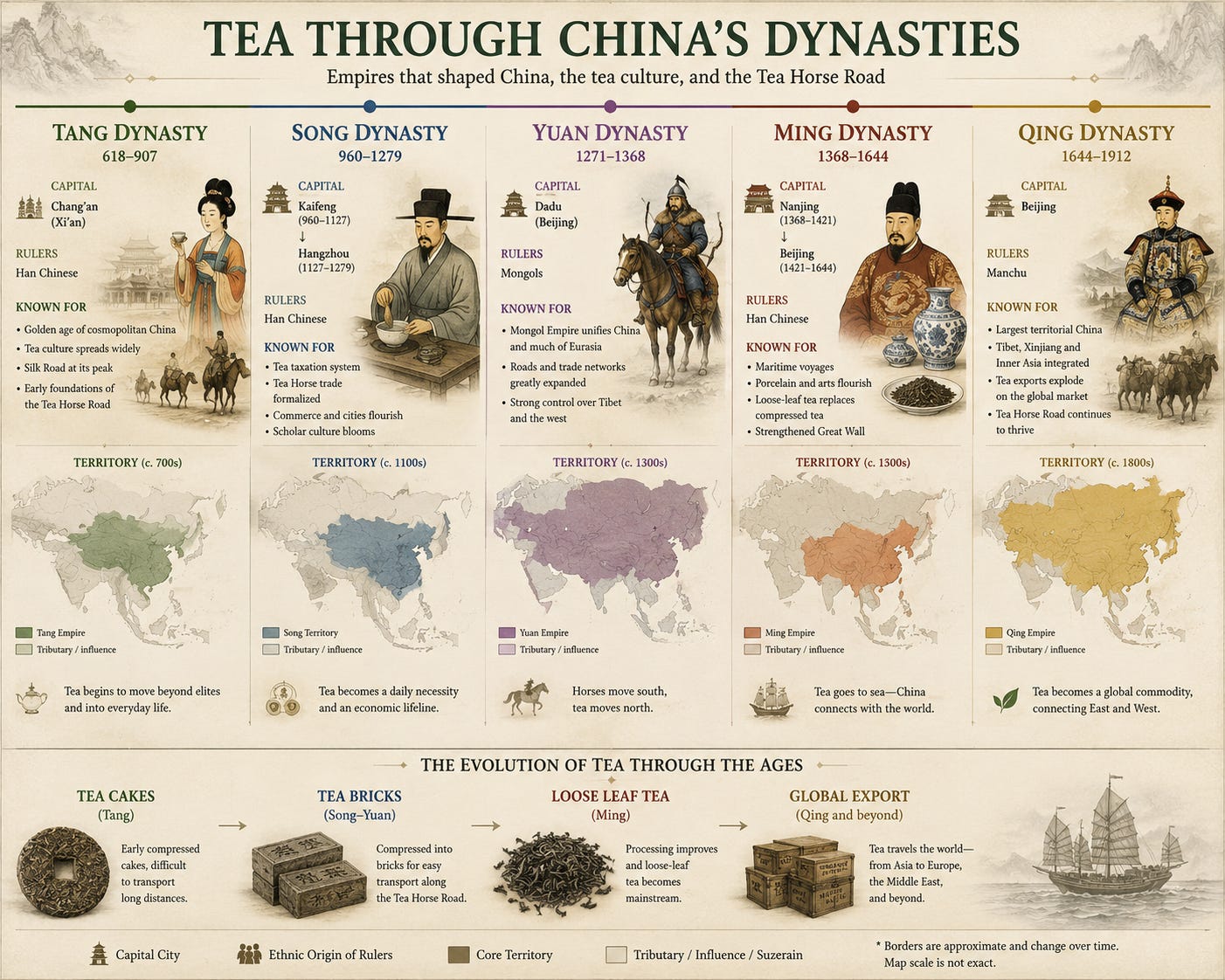
According to legend, Princess Wencheng of the Tang dynasty married into the Tibetan royal family in 641 AD. She brought with her some of the empire’s precious tea as part of her dowry and the Tibetan court embraced it.
Tibet is a high alpine environment, with little arable land forcing a diet heavily reliant upon meat, dairy, and animal fats. It was notoriously difficult to digest and tea helped offset the strain.
Its value was obvious, but it mostly remained among the royal and aristocratic classes during the Tang dynasty.
The Song faced greater pressure than their predecessors. The Liao, Western Xia, Jin, and other frontier foes tested their strength. That led to the creation of Tea Horse Agencies (茶马司), designed to regulate tea monopolies and institutionalize tea-horse trade.
This was welcomed by wider Tibetan society, which directly benefited from the introduction of more tea into their diet and lifestyle. It became a part of daily life, often combined with fermented yak’s milk as a calorie-rich staple. This evolved into an interdependence, with some historical accounts describing consumption exceeding a dozen cups daily.
As trade increased, an entire economy developed around it, including the standardization of production methods, weights and measures, pricing, and transportation routes. Tea was compressed into bricks and then loaded onto caravans for transport. They weren’t just creating an agricultural product, but a transregional commodity.
The Song saw something even larger taking shape: an opportunity to build not only a controlled trade network, but one that could finance the empire.
They went to work building one of the most sophisticated commodity-control systems in pre-modern China.
Farmers had annual production quotas and government sales requirements. Merchants needed licenses, permits, certificates, and state authorization. And the consumers supplemented all of it by paying inflated prices for their goods.
The Song intensified demand and expanded trade for a resource they desperately needed. Then monopolized production and monetized every layer of the network. It was the kind of statecraft that sustained empires for centuries.
For those on the ground though, things weren’t so simple.
The route spanned tropical jungle, steep hillsides, and Himalayan mountain passes at elevations in excess of 15,000 feet, making it one of the harshest sustained trade routes in human history.
Journeys along the main line from southern Yunnan to Lhasa in Tibet lasted 4–6 months, at a pace of 15–25 km (9–15 mi) per day.
Men carried bags of tea bricks, food, and other goods in baskets that they balanced on bamboo frames and slung over their shoulders. Porters routinely carried loads of 60–90 kg (130–200 lb). Mules, horses, and even yaks would carry roughly the same.
A small caravan might consist of 10–20 animals, a few porters, and some local guides. Larger ones could include religious leaders, extra handlers, and even security to ensure safe passage.
Mule bells, prayer chants, and creaking wooden frames dominated the soundscape, set against towering cliffs, endless ice, and dense jungle.
It was common for caravans to be lost without notice, merely slipping off a hillside into the abyss. The losses were built into the economic model, but the human toll was not.
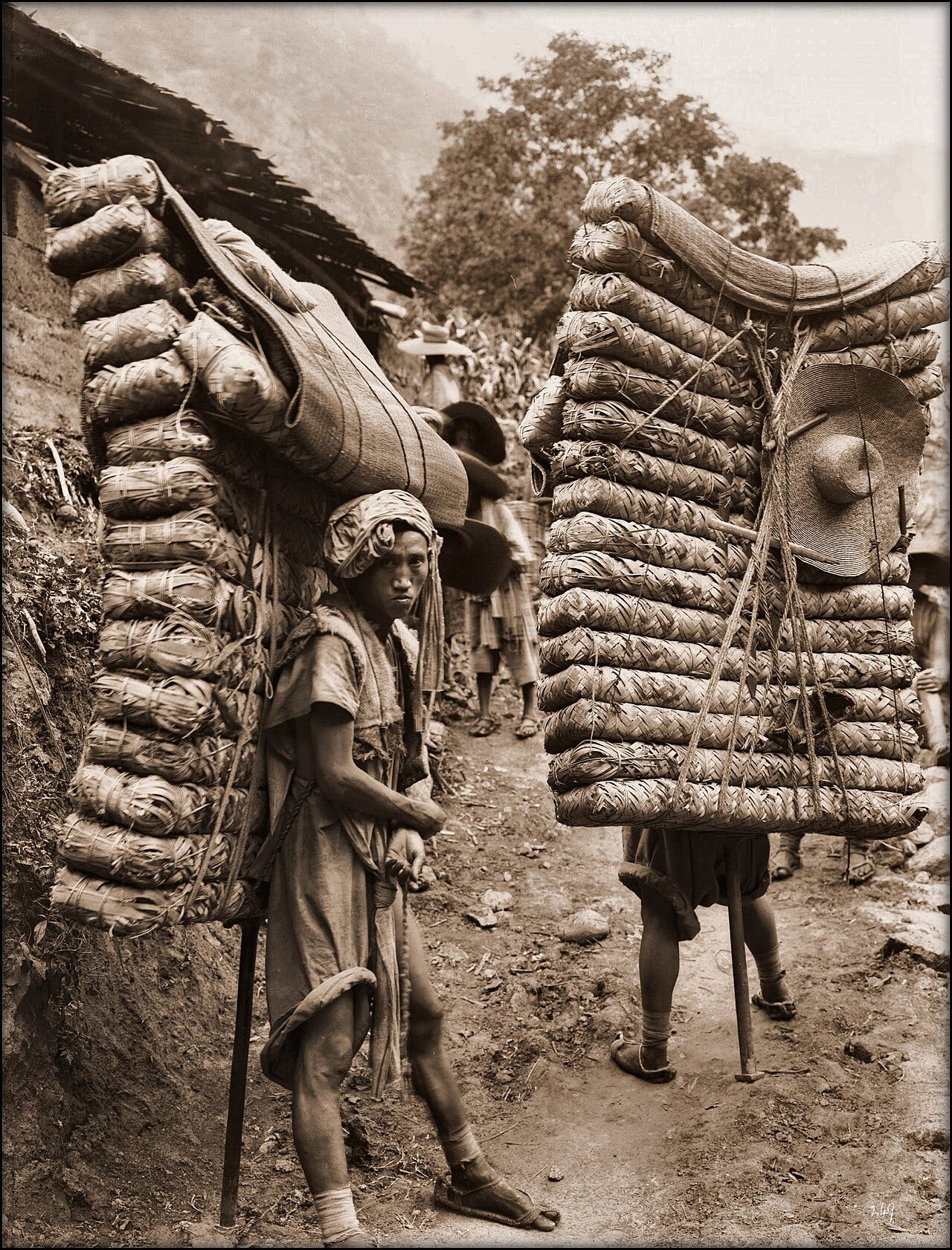
It should not come as a surprise then to learn that those who sustained the system weren’t the ruling class, but mostly smaller ethnic groups on the empire’s southwestern frontier.
Minority communities such as Tangut, Dai, Tibetan, and Blang were central from cultivation to transport and trade.
This increased the strategic importance of the region. With each tea brick they made, they were essentially printing money.
And while tea was responsible for the journey, over time, the journey began to influence the tea.
Tea is a living product that changes with its surroundings: it soaks up smells, slowly ferments, and loses tea polyphenols and caffeine with age.
The tea that showed up in Tibet and Beijing wasn’t the same tea that left Yunnan. So the tea makers had to adapt.
Over time they started to make tea that didn’t just survive the journey, but thrived because of it. Modern Pu’er builds on the fermentation process that was once incidental, where cakes are stored for years in aging warehouses, inextricably linking product with passage.
Today the Ancient Tea Horse Road is a distant memory. It faded slowly during the 20th century with the advancement of mechanized transport and industrialized warfare. Cities were built upon some of its most important trade posts, but most of the rugged overland route has been returned to nature.
After nearly 1,200 years of activity, history has largely folded it into the extended Silk Road network and awareness has dwindled outside the regions it once connected. But its legacy shaped the geopolitical landscape, helping create lasting economic and political interdependence between neighboring powers and successive Chinese dynasties.
Most of all, it represents one of history’s clearest examples of a single commodity shaping an entire regional economy. That model still exists today; just look at the petro-states in Latin America and the Middle East. Imagine entire regions being almost entirely reliant on a few bottlenecks, with empires relying on their stability.
The Himalayan steppe of old is the Strait of Hormuz today. Because while the subject matter may change, the dynamics that drive conflict do not.
Sources
National Geographic — The Forgotten Road of Tea and Horses
Silk Road Foundation — The Ancient Tea and Horse Caravan Road
American University Silk Road Journal — The “Ancient Tea and Horse Caravan Road”: The “Silk Road” of Southwest China
Love these — keep it up!
Those men laden with huge piles of tea is incredible and also not surprising that their deaths were not accounted for. Sad.