

Watch the Journey Unfold:
📸 Instagram | 🎥 TikTok | 🎬 YouTube
The fog came in thick and held on throughout, causing the granite columns cloaked in vines to disappear into the sky above. The drive wound through hairpin turns secured by minuscule barriers, sheer drops waiting beyond them. We sped through every curve, each blind stretch taken more than halfway over the dividing line, hoping for the best.
So how did I end up banking corners at twice the speed limit, scaling this otherworldly landscape? Because tea has a tendency to favor the remote, towering, and serene. This was no exception.
Tea and Buddhism became intertwined during the Tang dynasty (7th–10th centuries), when both tea culture and Chan (or Zen) Buddhism began to spread widely throughout China. Monks initially took to the drink as a form of medicine, before quickly finding it an apt tool for maintaining focus during meditation. Much like coffee would later spread through Sufi devotional culture in the Islamic world, tea became intertwined with Buddhist monastic life.
Tea was a simple ritual requiring mindfulness while promoting harmony with the world around you. The two were a natural fit.
Buddhist temples became more than just spiritual centers where tea was consumed. They became testing grounds for the growth, production, and consumption of the plant itself. They helped shape the tea culture we still associate with today.
One of my main goals for this trip was to experience it firsthand. What better place than Wuyishan, where both black and oolong tea originated among the region’s cliffs and valleys, and whose landscape was later designated a UNESCO World Heritage Site for its “Red Mountains and Jade Waters.”
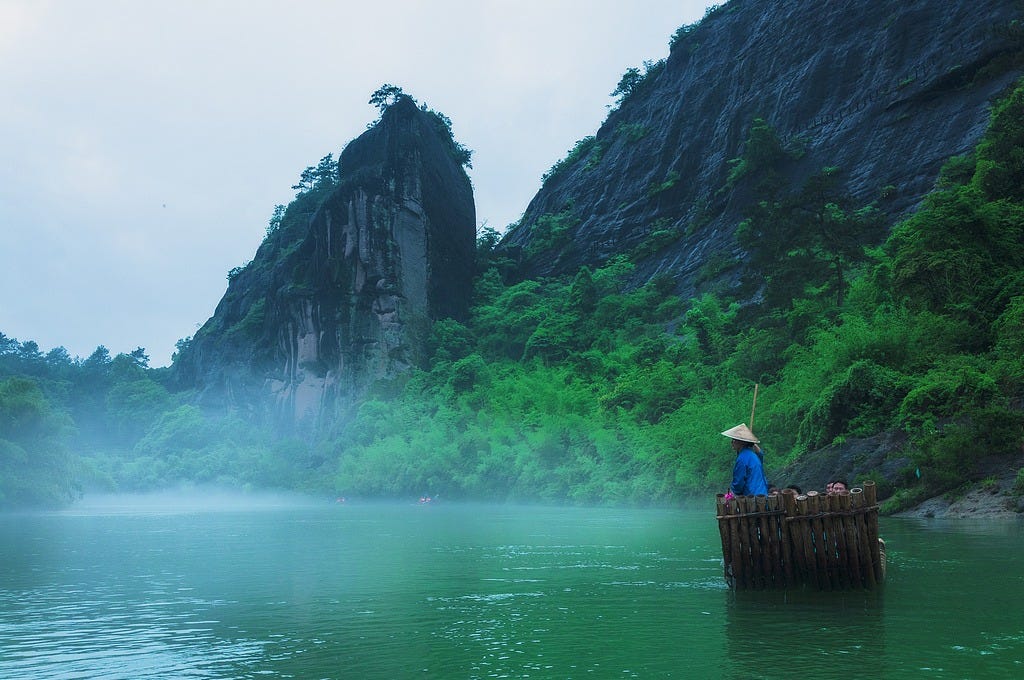
The complex at its peak is known as the Tianxin Yongle Zen Temple and traces its roots back to that initial spread of Chan during the Tang dynasty. But this place isn’t just a beneficiary of tea’s history, it’s a foundational part of it.
Tianxin Yongle is widely regarded as the birthplace of Da Hong Pao, or big red robe, the world’s most famous Oolong tea. And it brings the kind of tourism you’d expect along with it.
When we first arrived I got nervous, as flag-totting tour guides led throngs off their buses. Another sacred site, lost to tourism. I cynically resigned myself to it. Thankfully, our first stop was a secluded gazebo where we met Tian Chan.
Tian Chan was a fresh-faced monk somewhere in his late 40’s, but was only ordained in 2022. Before that? He was a banker in Malaysia.
“I came here to volunteer and I had never felt so at peace,” He said, a gentle smile of inner calm swept across his face. “So I came back for good.”
It turns out his story wasn’t unique. There was a mix of career monks and mid-life converts among the ranks. Partly because the qualifications weren’t as strict as I envisioned. No entrance exam, diploma, or rigorous trial period. Instead, “understanding the texts and being prepared to live this lifestyle.”
Vegetarianism, abstinence, and 5 a.m. wakeups included.

My first morning in the temple complex started earlier than usual to attend morning prayer, the day’s most important. I stayed toward the back, following as closely as I could for 30 minutes of standing meditation. Then, the room quickly shifted into another half hour of synchronized walking, chanting, and hand motions around the temple’s main hall. Drums thumped with every beat, incense wafted by, cymbals rang out across the hall. Whether you wanted it or not, the rhythm pulled you in.
Then, as suddenly as it had begun, the main hall emptied in a matter of seconds. We met Tian Chan outside, without acknowledgement of the sacred ritual we’d just experienced. We ate a communal breakfast, which was followed by a tour of the temple grounds, explaining every chamber, decoration, and deity. He led us through a Qigong session overlooking the mountains, and we met up with a few more monks, including one who spoke fantastic English after spending 12 years in Thailand.
They toured me around their tea plantations, whose finished product can reach 5 figures per kilo. This wasn’t just a coincidence.
Legend has it that a Ming-era scholar fell ill nearby en route to the civil service examinations, by far the most important avenue to social mobility in imperial China. He was found severely ill and was taken into the care of the temple’s monks, who healed him with the tea they’d grown. The young scholar regained his strength and made it to the exam in time to pass.
The newly minted imperial official returned to the mountain and wrapped the tea trees in red silk as a means of protecting them, giving the tea the name it carries to this day.
So the temple doesn’t fund itself through donations, it’s self-sustaining. More than covering their expenses with tea sales from the Da Hong Pao grown and processed in the surrounding grounds.

Eventually, it was time for tea. Our ever-growing crew departed for the living quarters, where the centerpiece was a massive tea table, likely 20-by-5-foot. We started with a variety of teas grown and processed on site. The mood was great, and the tea even better until one moment something changed. The room that had relaxed seemed to tense up a bit. Smiles faded into straight faces just as shoulders perked up. Not out of fear, but of respect for the gravity of that moment.
I knew he was behind me before turning around.
He came in with a quiet confidence, almost gliding across the floor, the bottom of his robe floating effortlessly behind him. Everyone gave a respectful bow, hands pressed together. Multiple seats were offered and he settled into the one opposite my own on the host’s side of the table.
This was the Shifu, abbot of one of China’s most historically important tea temples. His attendance that day was rumored but never confirmed. His name was never revealed, we were not allowed to share any photographs. But none of that was necessary to understand the weight of his presence.
He began asking me a few questions in Chinese to which my translator stepped in and answered on my behalf.
“America?” He took a beat, his facial expression noticeably changing as he stared into my eyes.
Uh-oh.
After a moment, he continued. I waited anxiously, the last person in the room to be clued in. “You know we call this tea Da Hong Pao. Maybe this would be a good one for you to bring back home because you all seem to look so beautiful.”
I laughed on the outside, but on the inside it was a sigh of relief.
After an hour or so, he beckoned me to the other side of the table. It was my turn to prepare tea. It felt as though I had been asked to lead grace at a monastery on no notice. He watched intently as I tried to put all of my skills up until that point to use.
Pour the water off to the side of the tea, immediately replace the lid. Thumb and middle finger on either side of the rim, index finger over the lid, leaving a couple millimeters of space between the two. Elbow tucked, wrist flicked confidently, but without too much panache.
A slow tilting of the gaiwan over the gong dao bei.
As the tea gently flowed from bowl to cup, I could sense a collective exhale from my traveling party. The Shifu nodded in approval, and my teacher did the same.
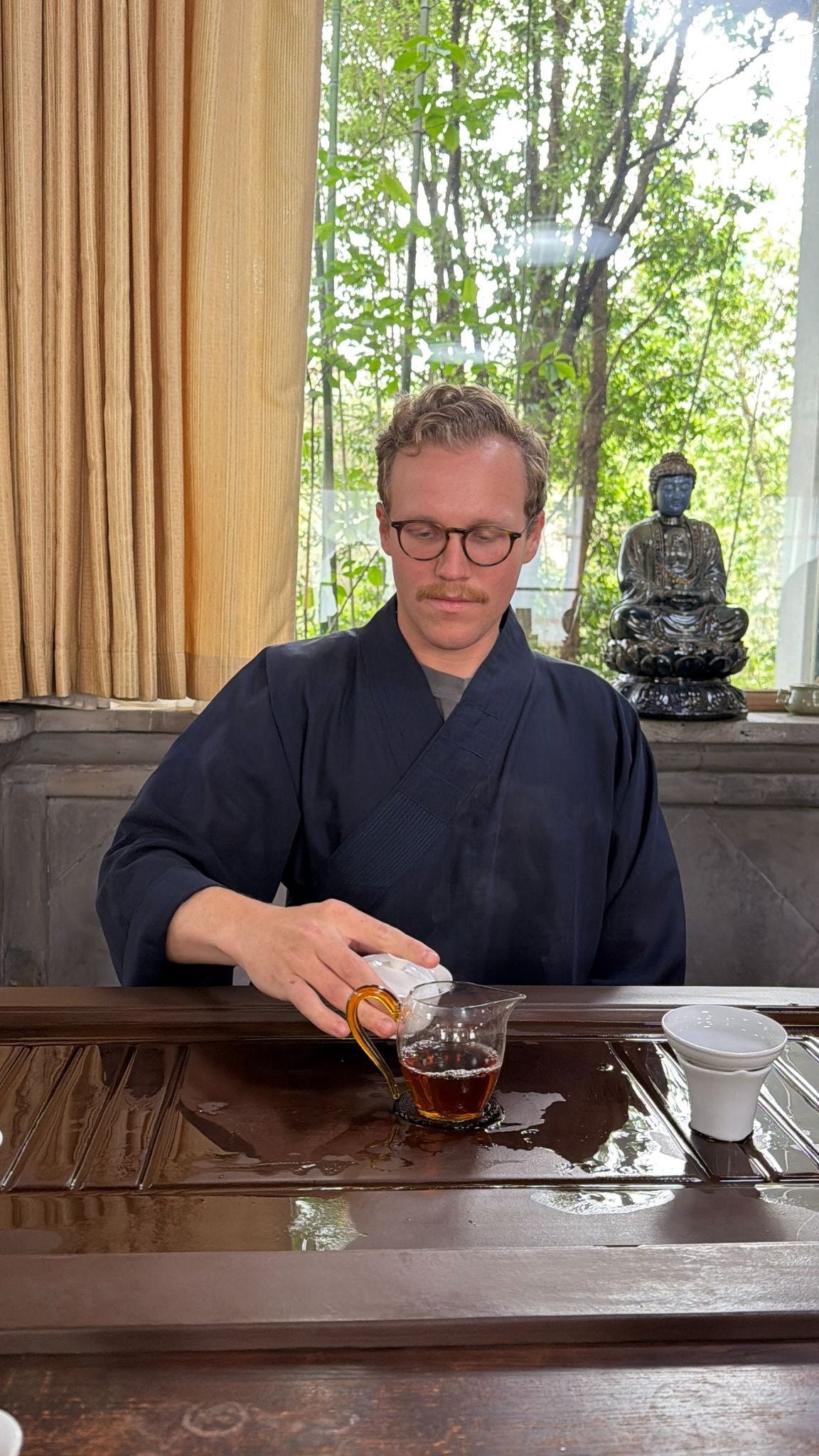
After that, the rhythm came naturally. Before I knew it, one of the monks was slipping off his outer robe and placing it over my shoulders. As I returned to the host’s chair, the Shifu began discussing my month-long residency, which he then extended to 3 and finally 6 months.
Surrounded by genuine love, awe-inspiring nature, and deep introspection, it was hard to say no. Quite honestly, it felt like it actually might be the best thing for me. I can be a vegetarian for 6 months and 5 a.m. isn’t too early if I just get to bed on time. Romantic relationships would be harder to talk around, but I can get to that one later.
My short period of entertaining the idea came to an abrupt end as almost all departures seem to happen in China. The Shifu departed as unceremoniously as he had arrived. A few seconds later he was out of sight.
I was left to wander through the vast corridors on my own and I reflected back on an anecdote earlier in the conversation.
“People come to the temple looking for answers” he said, almost bemoaning it. “And a monk’s response is always the same: go and drink tea, go and drink tea.”
When I first heard it, I was a bit disappointed. Part of me had been hoping for some kind of revelation. Some tea-prayer wisdom that could help unlock the secrets I set out to find.
But maybe that’s not how Buddhism – or life – works. The monks weren’t holding back on their advice out of selfishness. They do so because they believe the answers are already within you. To them, tea is the vessel to uncover them.

In the days since my visit, I’ve looked at tea a little differently. I’m less focused on consuming as much information as I can: age, steep time, leaf quality, and more on the act itself. All previously in service of gaining the knowledge and authority I feel is required to speak on the topic.
Instead, I have tried to take a different approach.
To drown out the noise. Allowing every drop to trickle out. Every hand movement to sit with intention. And to carry a piece of their teaching with me for the rest of my life.
Sources
UNESCO World Heritage Centre — Mount Wuyi
Britannica — Wuyi Mountains
Teasenz — The Legend of Da Hong Pao Tea
Serious Eats — The Ancient Chinese Ritual Behind a Favorite Green Drink
Great wisdom and info. I wish I were there with you! Stay safe😘
i thought for sure you were going to stay....this is my favorite post thus far. it conveys beautifully that moment where you make the leap, transcending from the mind-the facts and quantification of the world of tea- to the introspection that comes with the ritual and quiet of preparing and sipping it. going ever deeper....brilliant.