

Watch the Journey Unfold:
📸 Instagram | 🎥 TikTok | 🎬 YouTube
It feels like every Chinese tea market begins the same way.
The gates are ornately decorated, dragons twisting around towering figures painted in pastel colors. It then opens up to cavernous concrete buildings with space for hundreds, if not thousands, of vendors to sell more or less the same three products: tea, teaware, and tea packaging.
And there is one more similarity I would add: they’re empty. Unlike the luxury malls and tourist promenades filled with shoppers, the tea markets I visited were filled with vacant storefronts. Those that remained were stacked to the ceiling with boxes, the owners staring deeply into their phones, a cigarette dangling between their fingers, sipping their own supply.
I was told many of their buyers were elsewhere, or handled through distributors. But it’s in stark contrast to the books I’ve read describing these markets overflowing with customers. Times when nearby banks halved withdrawal limits to prevent a run on cash reserves and pedicabs sold tea to anyone who would listen.
In 2007 Pu’er tea lost between 70-90% of its value. In 2014, 50%. The current freefall has yet to find bottom.
Each time, it felt like a warning of what was to come.
Modern China is not communist in the way many Westerners imagine. In the decades after the 1949 revolution, the country remained poor and economically isolated. Yet, with Mao Zedong’s passing in 1976, Deng Xiaoping became the country’s de-facto leader and he came up with a different approach:
“It doesn’t matter whether a cat is black or white, as long as it catches mice.”
His logic was simple: a few people had to become wealthy before the masses could prosper.
So in 1978 China opened its doors to the world. At the time, its GDP was less than 10% of the U.S. economy. Within fifty years, it would challenge it for the world’s largest.
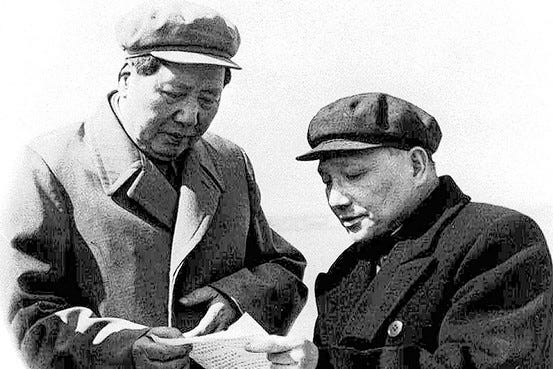
Crucially, China’s wealth boom wasn’t just felt at the top, but also across a burgeoning middle class that had disposable income for the first time in its history. In the West, we have a preference for wine, art, cars, and watches as stores of value. The Chinese found these alluring, but they also looked closer to home: Pu’er tea.
Between 1999 and 2007 the price of some Pu’er tea increased 1,000%. Outpacing gold, equities, and nearly every major Chinese asset class. There was a saying at the time:
“It’s better to save Pu’er than to save money.”
They were about to find out why that wasn’t really the case.
Pu’er was naturally positioned for abnormal market behavior. Its ability to improve with age encourages stockpiling and speculation. And because true Pu’er can only be produced in Yunnan, supply was naturally constrained.
Then there are the structural vulnerabilities. It’s extremely difficult to authenticate and pricing is opaque, meaning forgery and manipulation are rampant.
Most of all, luxury markets depend on scarcity. From 2006 to 2007, production doubled from 50,000 to 100,000 tons, while producers from around the country shipped product to Yunnan to be labeled as Pu’er, flooding the market with counterfeit tea.
Once buyers began doubting both scarcity and authenticity, the market unraveled quickly.
The institutions left first. And like other speculative markets, once momentum reverses, the collapse feeds itself.
It was crushing. At least one-third of merchants and manufacturers quit within the first year. Medium-grade Pu’er fell to roughly $3/lb, after its prime counterparts had fetched as much as $150.
Villagers quickly shifted back to farming rice and corn. Some market participants took their own lives. It was a regional collapse that foreshadowed how the Great Financial Crisis would reshape the global economy.
But that crash wasn’t the end of Pu’er. Because out of the rubble, something else emerged: financial tea (金融茶).
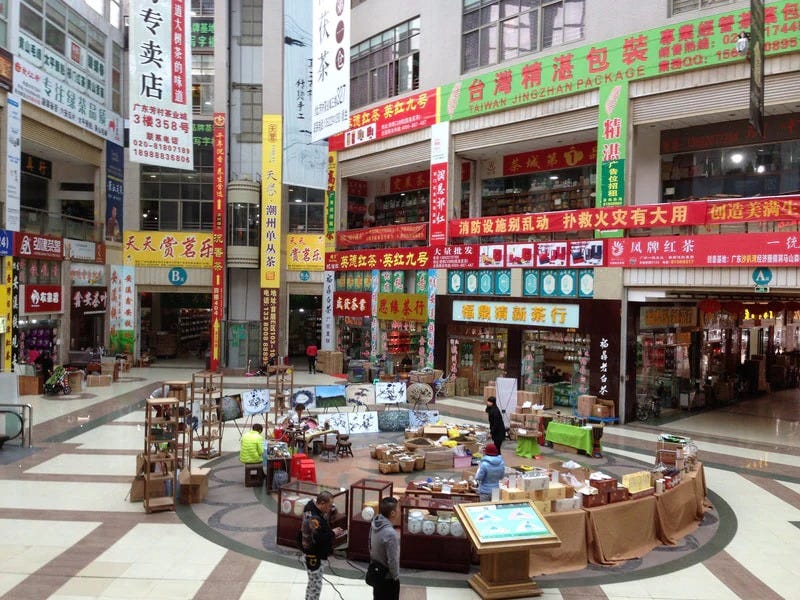
Guangzhou’s Fangcun is tea’s hidden Wall Street. Originally, it was China’s largest traditional tea market selling all the tea and teaware you could imagine. In the 2010s, an invisible commodity market began to emerge within it. Investors stopped taking delivery of tea and instead traded receipts, eventually buying lots before they were even finished.
Imagine if 95% of Bordeaux buyers never drank the wine. The cases never left warehouses and owners simply traded the rights to them online.
Fangcun began to resemble the Chicago Mercantile Exchange, but instead of soybeans or wheat, they were trading tea.
But unlike the CME, there is no trading floor in Fangcun. Instead, it grew out of storefronts and WeChat groups. So while the first Pu’er crash was due to a supply/demand imbalance for tea itself, its later valuation barely had anything to do with the product at all.
Suddenly tea wasn’t valuable when it was good, it was valuable when it was liquid.
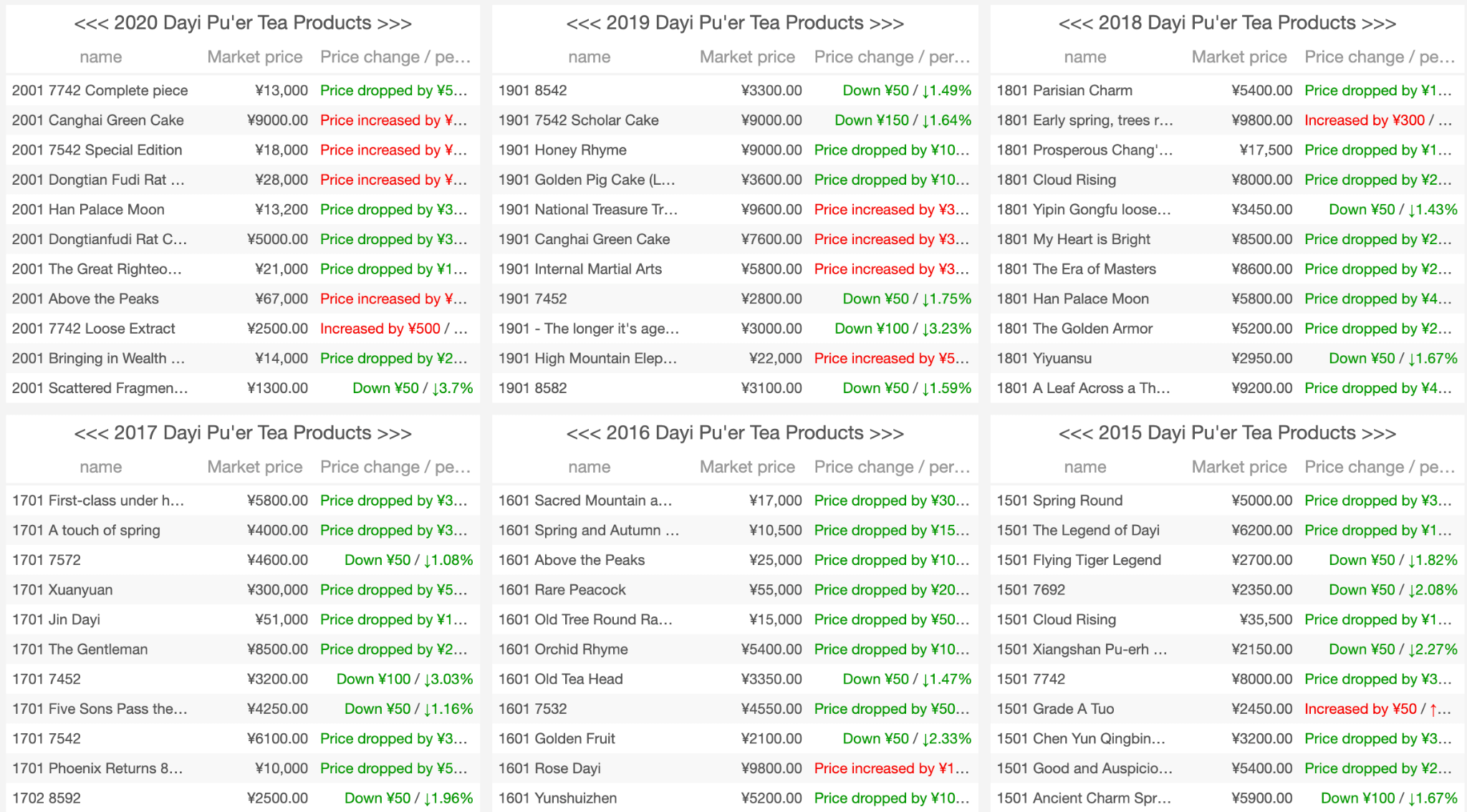
That’s why the world’s most valuable Pu’er was no longer single-origin tea cakes or prestigious blends from high-value gardens. Instead, it became benchmark teas like Dayi 7542.
Dayi 7542 is a raw Pu’er tea blend from Chinese giant Tae Tea. Its name comes from the year the recipe was developed (1975), leaf grade (4), and factory designation (Menghai is enumerated as 2). It turned an otherwise bespoke product into something standardized and easily tradable.
That standardization made financialization possible. By 2012, financial teas had largely regained their pre-crash values. Within a year, they had surged again, rising between 75% and 250%.
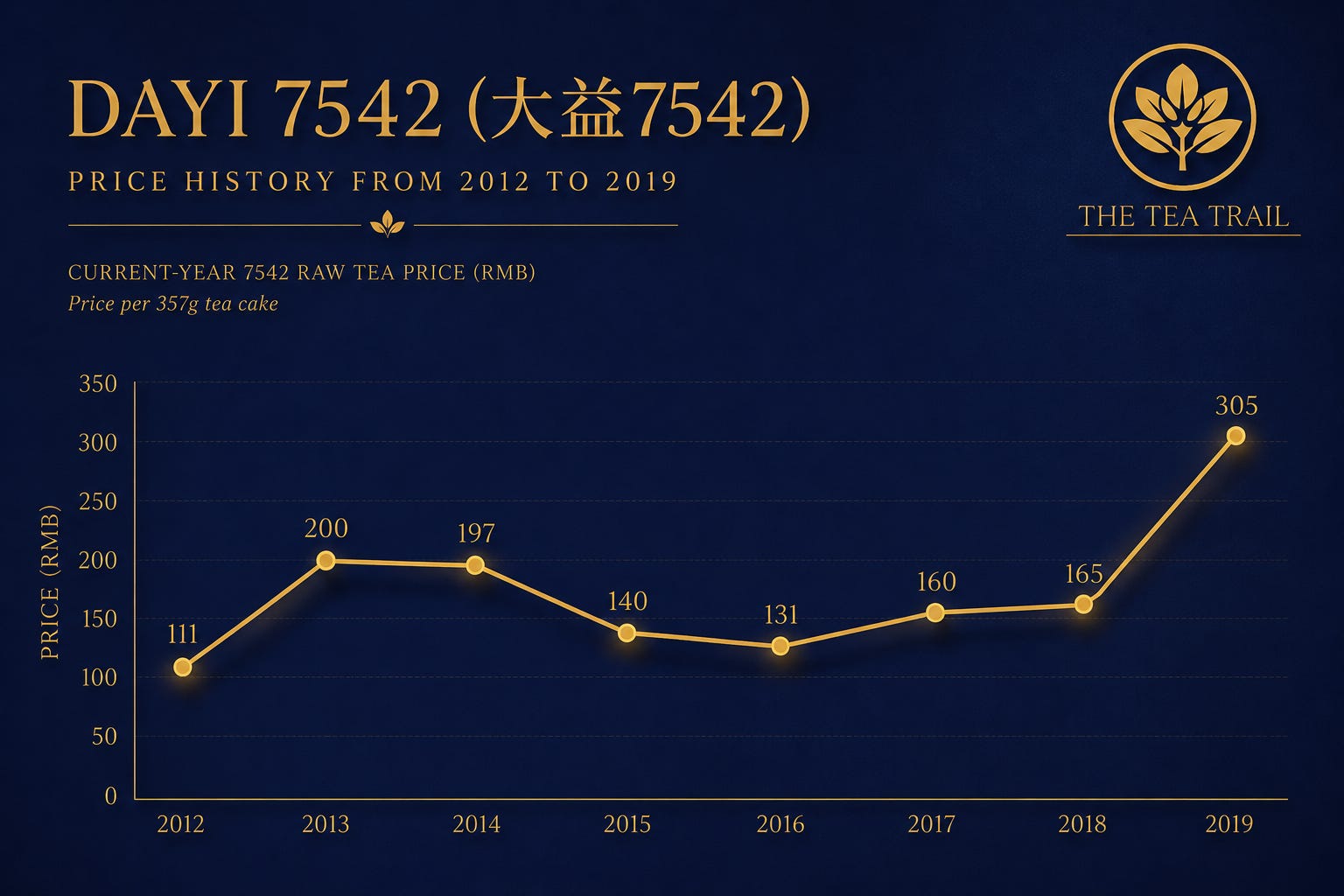
Prices grew because people expected them to. That worked for some period of time, but inevitably, new speculative capital dried up and another crash followed, with up to 50% declines through 2016.
The first crash was rooted in oversupply. The second was rooted in speculation.
In 2007 tea producers broke the market, in 2016, the market broke itself.
But unlike 2007, belief in financial tea never disappeared. Prices stabilized quickly, and by 2019 they went parabolic once again. In normal circumstances this may have led to a quick compression, but like just about everything else during COVID, the price of Pu’er exploded.
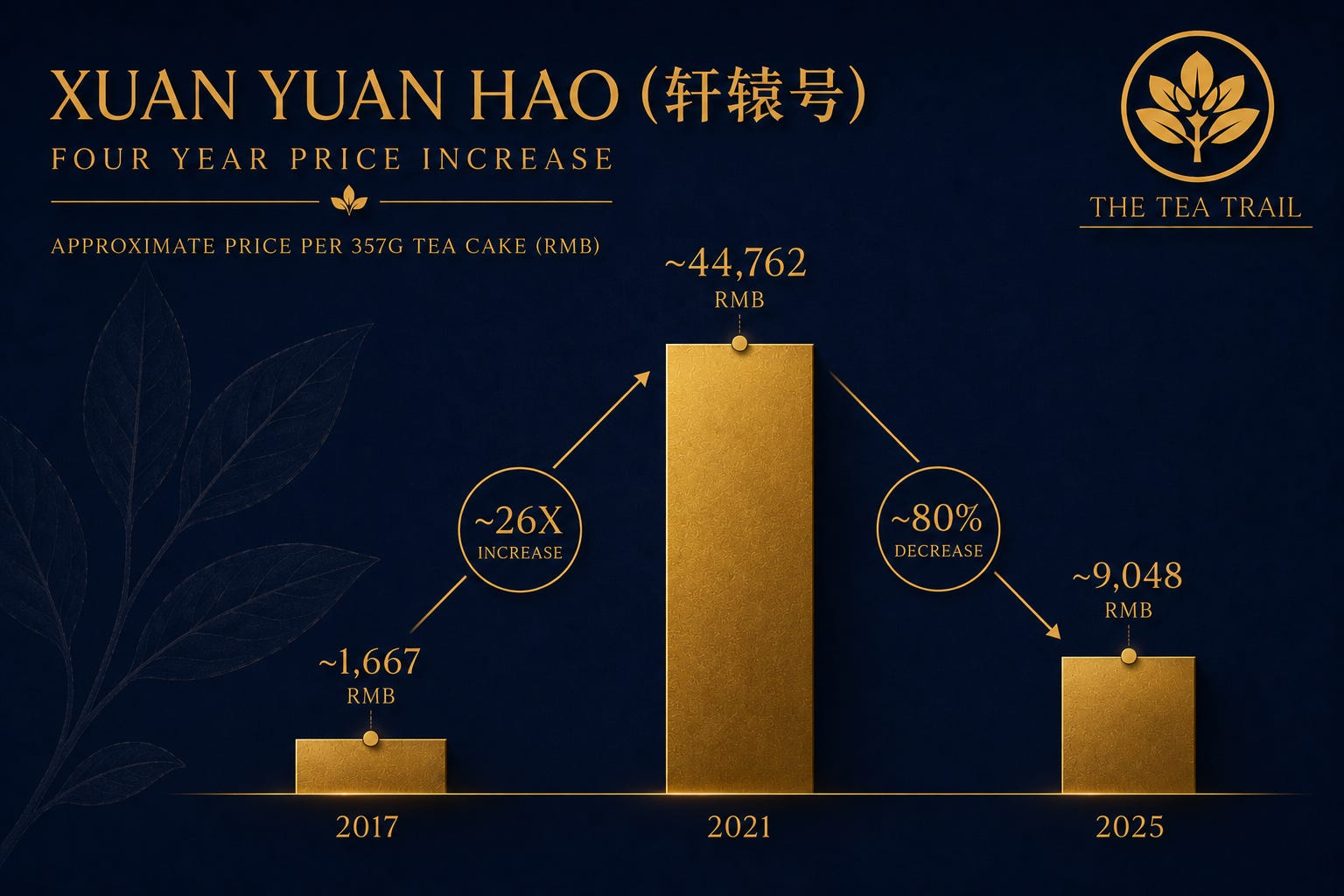
By 2021, certain teas like Xuan Yuan Hao (轩辕号) increased 25-fold in four years. Standard packages traded for the price of luxury cars.
Then, the Chinese economy began to slow.
Today, businesses aren’t sending gifts the way they once were. And while the stock market gains, ordinary people don’t feel it at all. I lost count of how many times I heard: “the economy is not good and it hasn’t been for years.” More than once, I walked into a shop where the owners sat in darkness to save on electricity.
The price of some teas has fallen by as much as 80% from their pandemic highs. Corporate showrooms are boarded up. Those that remain have four employees for every customer. While farmers and producers are once again trying to figure out how to sell something that once sold itself.
After an impromptu visit with a tea boss in Jingmai, the laoban led us down to his warehouse, passing two Porsches on the way in. As he opened the door to the dark room, we were dwarfed by the cardboard boxes piled to the ceiling, more than 15 feet high.
He cleared us a path to the back, rummaging past bags of tea that had been there for far too long. He handed us each a kilogram of fresh maocha from the recent spring harvest.
“I have more than I could ever sell. At least this way someone will actually drink it.”
Sources
A County in China Sees Its Fortunes in Tea Leaves Until a Bubble Bursts — Andrew Jacobs, The New York Times
How Is Market Reading the Tea Leaves as China’s Puer Bubble Comes Off the Boil? — South China Morning Post
China’s Pu’er Tea Market Cools as Financial Tea Bubble Deflates — The Epoch Times
Making “Senses”: The Qualia of Pu’er Tea and Sensorial Encounters Between Tea Producers and Traders in Southwest China — Zhen Ma
Price Prediction of Pu’er Tea Based on ARIMA and BP Models — Zhi-wu Dou, Ming-xin Ji, Man Wang, Ya-nan Shao
Predicting Pu-erh Tea Prices Using Machine Learning Techniques — B. Balamurugan, S. Pradeep Kumar & R. Lokesh
Pu’er Tea in Flux: Intersections of Financialization and Digital Capitalism in China — Yutian Wong
Great explanation of a complex and little known market
Connor, when I look at the 2017 Value of about about 1,667 RMB and the 2025 value of over 9,000 RMB it would appear while an 80% drop from the pandemic highs it it still more valuable thank 8 years ago. So if you were a farmer holding on to physical inventory, you would still be profitable.
Is there any hope for profit left in tea trade? If so, where are they finding it today?