
Watch the Journey Unfold:
📸 Instagram | 🎥 TikTok | 🎬 YouTube
The final minutes were ticking down in Japan’s opening World Cup match against the Netherlands. The Samurai Blue were down 2–1 and the room had grown noticeably tense. A few men sat, hands wringing. Some paced near the undersized television. Others stood motionless, seemingly resigned to a disappointing result.
Then Daichi Kamada put one in the back of the net and the crowd erupted. A celebration worthy of a proud nation with deep tournament aspirations.
But suddenly a voice came over the loudspeakers and the focus quickly shifted.
The clock was about to hit 7:00 and the doors to Japan’s largest wholesale tea market were preparing to swing open. I got in line, but craned my neck to see if any more last-minute heroics were in store.
We’re not going to wait five minutes?
I walked into this building for the first time a few days earlier expecting baskets of overflowing tea and hordes of people coming in and out. Instead, I found an office park. Inside the entryway, there was a laboratory to my right and rows of workstations to my left.
It was quickly established that this market wasn’t open to the public, plus there wasn’t even any tea there. But after making my way through a few different representatives I found myself invited to Monday morning’s auction.
“Be there at 6:50… maybe even a bit earlier,” the host was already skeptical of my interpretation of punctuality.
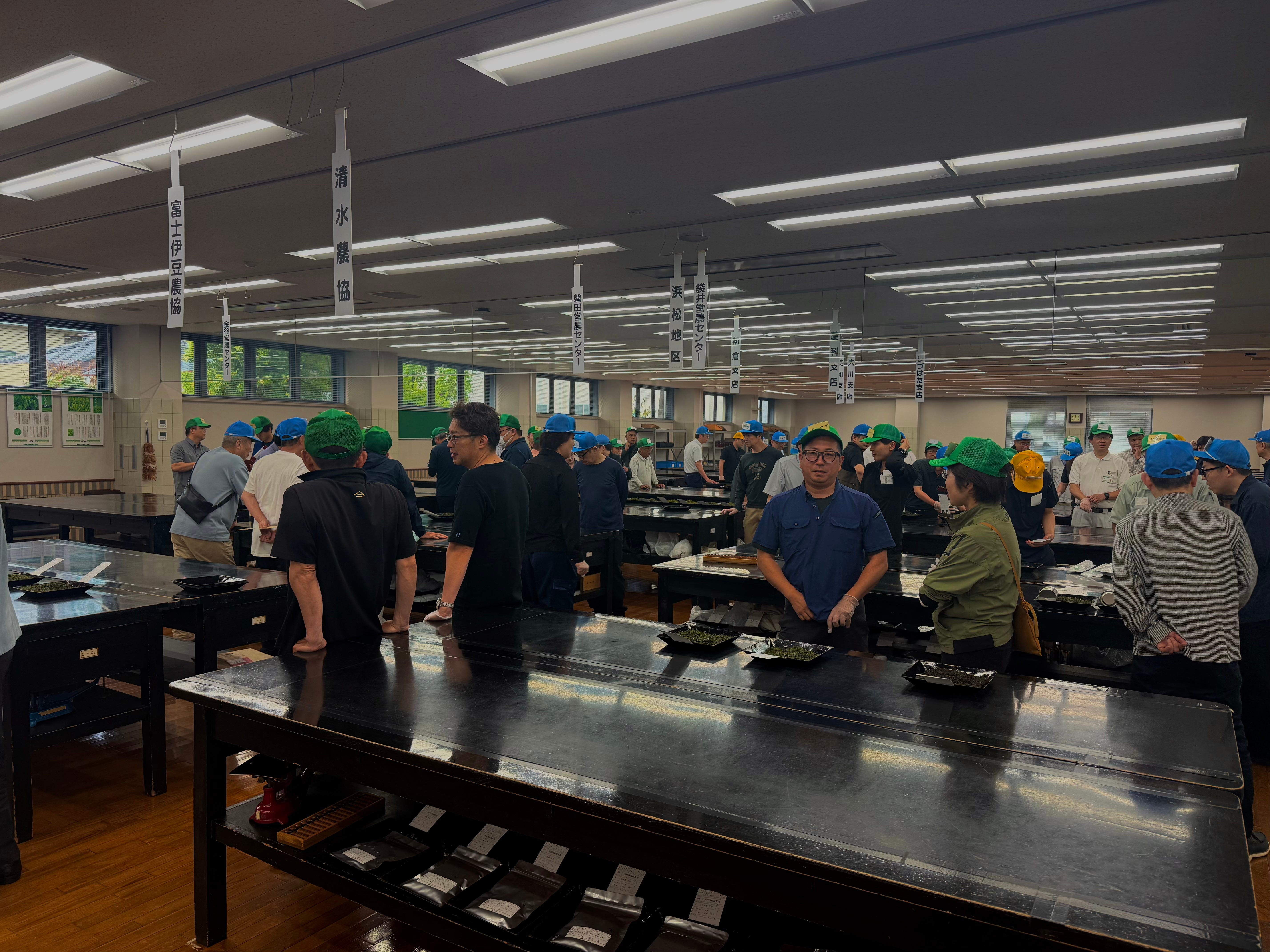
I walked through the doors at 6:40 sharp. The empty hall I’d seen a few days before was already filled with about 100 people, each wearing a hat corresponding to their role. Tea farmers sported green, marketplace employees wore yellow. Light blue was for the press, red for government officials.
But the largest group wore dark blue, donned by merchants waiting outside the exhibition hall’s doors. An exclusion no one seemed to be particularly upset about on match day.
Tetsuya walked in and bestowed upon me a dark blue hat of my own. “You need to wear this, otherwise you can’t go inside.”
As soon as the doors opened, blue hats flooded the room and merged into the sea of yellow and green. They rushed to tables lined with black plastic trays filled with tea from the prior day’s harvest. Their job was to quickly assess the tea’s quality and begin negotiations before another buyer could claim it.
They first inspected the raw leaves, taking handfuls and shaking them out from above, activating their aromas. Anything under serious consideration was scooped up and carried over to tasting sinks where 15 industrial-sized kettles blew steam from every opening, always at the ready.
My host, Tetsuya, is the president of the Shizuoka Tea Association. A sixth-generation tea merchant and 10th-level tea master, he is one of only 30 people to have achieved the country’s highest ranking in its 70-year history.
“And half of them are from Shizuoka,” he added.
So this market is often home to the greatest density of Japanese tea experts in the world and I had the pleasure of seeing it through the eyes of one of the very best.
Standing just outside the rush of passersby, Tetsuya explained that they were currently in a seller’s market.
“There is still rising demand for tencha,” he said, referring to the semi-processed tea eventually turned into matcha. Many farmers had invested in the equipment required to produce it, as tencha can fetch prices 3-4 times higher than the more common sencha.
We moved past them to a set of second flush senchas, their leaves larger than the rest. “Most second flush is now being used for RTD (ready-to-drink). So the way it’s cut doesn’t matter as much because the consumer will never see it.” He lingered on that thought for a moment until we were interrupted, joined by the local journalist who first introduced us. It turned out he’d been stewing on a question for him.
“How much less tea was sold in the first flush compared to last year?” Tetsuya asked.
“10%,” he replied.
“And the harvest yielded 30% more tea per acre,” Tetsuya added.
Supply and demand going in opposite directions.
The organized chaos of tea bargaining continued in the back of the room. Once a buyer was ready to negotiate, they called over one of the market reps to facilitate the trade. Everyone appeared calm, and while I could only read body language, there seemed to be a mutual respect for the other’s expertise. Once they started talking numbers, the rep would make calculations with an abacus, their fingers displaying the dexterity of a concert pianist.
This could have been happening a hundred fifty years ago.
The front of the room was different. There were two rows of trays with no seller at their side. Instead, a pool of buyers slowly circled the product like sharks, sizing up everything around them.
Because this year, the market introduced a new element: silent auctions run through an app.
We moved toward one of the special pieces in this section, a lot of first-flush okumidori tencha, rare for this late in the season. Starting bid: ¥5,000 per kilogram, already 2.5 times the price of anything else in sight.
“I expect it to go for ¥12,000,” Tetsuya said.
He was in the market for some tencha on behalf of one of his more discerning clients based out of Bangkok. I followed his lead as we used our gloved hands to grab a handful and bring it to our nose.
“You’re looking for umami and sweetness,” he sniffed intently. “Then the regional aroma that makes it unique.”
I raised some freshly brewed leaves to my nose. The first smelled of dull grass, while the second was much more vibrant. I took a swig of the oversteeped liquor meant to bring out its weaknesses. One batch was clearly better than the other, exactly as Tetsuya had described it.
“It won’t meet her standards.” Without another word, he was already walking toward the next tray.
“Much of the tea trade has relied on relationships,” Tetsuya said, a shared history that allowed transactions with limited information. “Some people feel that the digital auctions have the farmers taking advantage of a seller’s market when the buyers helped the sellers through bad times just a few years ago.”
During COVID, raw tea pricing was down more than 70%. Many businesses failed, others were pushed into early retirement, unable or unwilling to work through the pain. Tetsuya noted that if it weren’t for certain buyers continuing to do business with their normal counterparts, even paying inflated prices to keep them afloat, more would have folded.
But he also noted he wasn’t so sure that the changes were all that bad.
“The online system allows newer traders to buy or sell tea without established relationships.” A quick look around the room shows why. The room was occupied almost exclusively by older Japanese men.
What a silent auction does is ensure that the best tea wins, no matter who’s involved.
I found myself dwelling on the two modes of sale.
Which is better? A system that has little emotion, but also little bias? Or one that relies on partnerships in both good and bad?
What do markets actually value? And what should we value in them?
Questions I couldn’t answer.
But as I was ruminating, Tetsuya posed a question that hit much closer to home.
What happens when the rush for more is no longer there? Once ready-to-drink tea corporations and foreign buyers have enough to meet demand?
“They will stop buying, and I can’t blame them. That is their business,” he stated matter-of-factly. “But we will still be here, because this is our community, our heritage, and we must make sure that it survives.”
It was 7:45. Almost everyone had left. Tens of thousands of kilograms having traded hands.
It brought me back to less than an hour before. A hundred people willingly walking away from one of the biggest sporting moments of the year because work was about to begin.
Most hadn’t chosen the profession so much as inherited it—some stepping into businesses that dated back to the nineteenth century. For them, leaving the match early wasn’t abandoning sport in favor of work, it was exchanging one national pride for another.
To the rest of the world, Japanese tea is becoming a commodity.
For the people inside that room, it’s still a way of life.
Sources
Original reporting based on direct conversations with tea merchants, buyers, market makers, and industry participants at the Shizuoka Tea Market (静岡茶市場), Shizuoka, Japan. June 2026.
This was super interesting to read, and I can't imagine how interesting it must have been to be in the middle of it. I remember you were at the opening of the stock exchange; how did this compare?